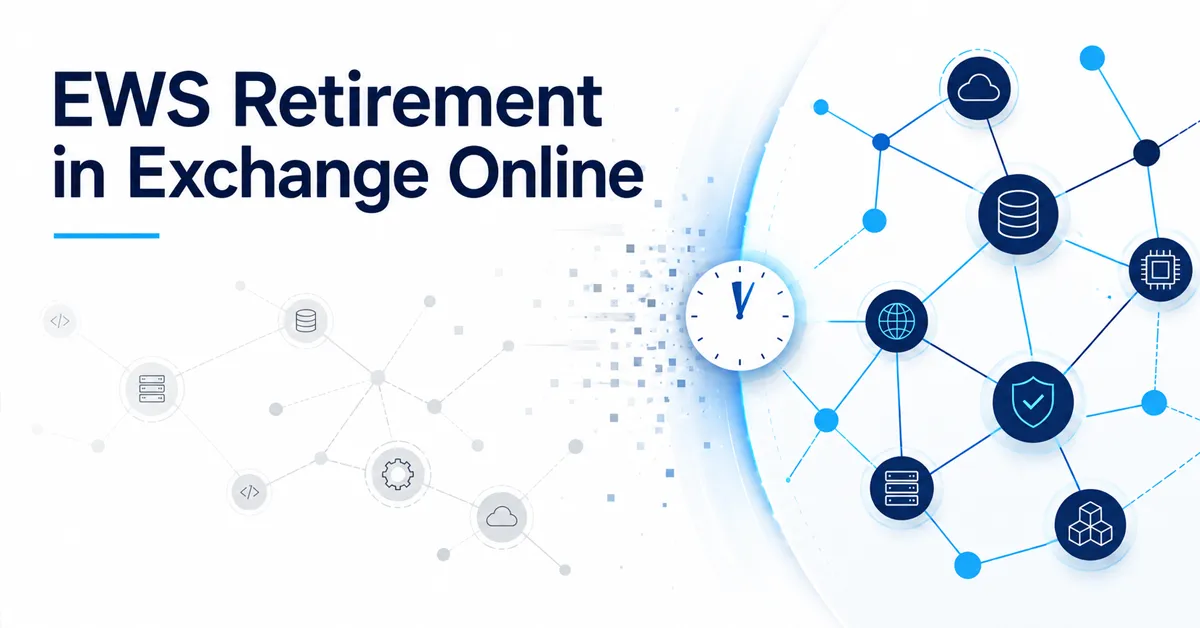
The EWS retirement in Exchange Online is entering its final phase, and there is a date before which you need to act if you want any say in how it happens for your tenant.
Exchange Web Services, or EWS, is an older Exchange API that applications use to reach mailbox data — messages, calendar items, contacts and folders. Microsoft is moving Exchange Online integrations off EWS and onto Microsoft Graph.
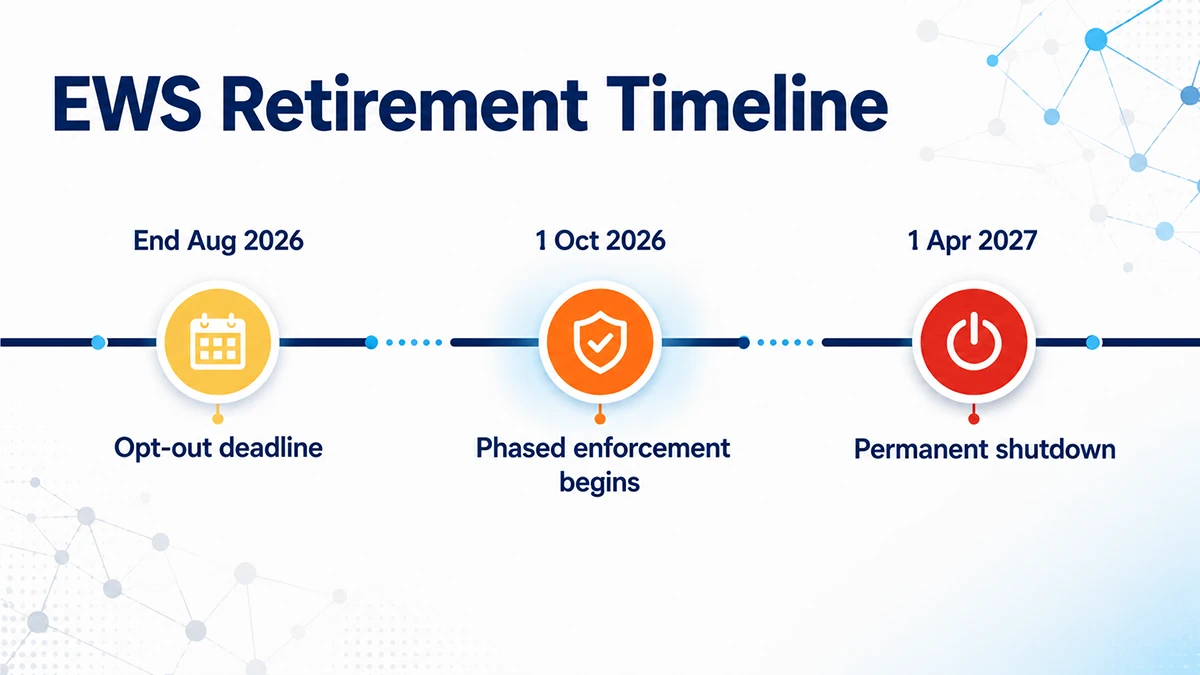
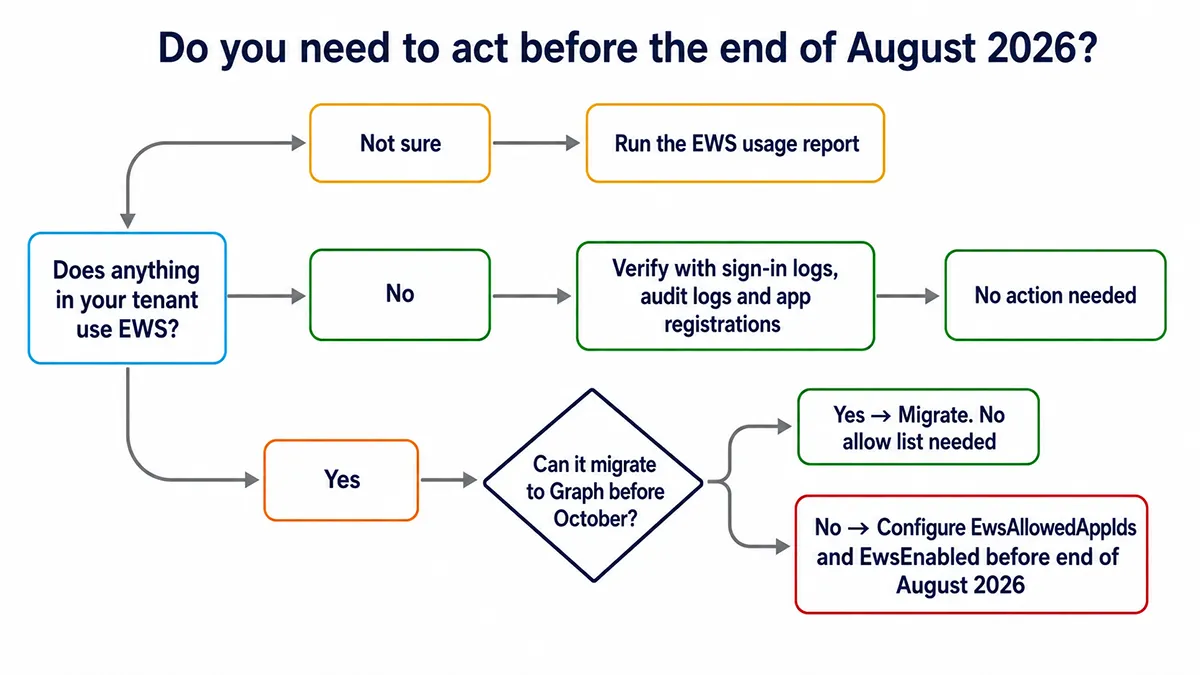
Microsoft begins tenant-level enforcement on 1 October 2026. EWS is not permanently switched off until 1 April 2027. But the date that actually matters to administrators is sooner than both: if you configure an allow list and explicitly enable EWS before the end of August 2026, your tenant is excluded from the automatic switch to EwsEnabled = $false on 1 October. Miss it, and EWS is turned off for you on Microsoft’s schedule rather than yours.
This guide covers how to find out whether anything in your tenant still uses EWS, how to buy yourself time if it does, and what the actual migration looks like.
Why This Is Moving Faster Than Earlier Deprecations
EWS has been formally deprecated since 2018, and for years the retirement felt theoretical. Two things changed that.
The Midnight Blizzard intrusion disclosed in January 2024 involved EWS, which made the retirement feel less like routine cleanup and more like a security-driven priority for many administrators. Around the same period, Microsoft widened the scope from third-party applications to include its own products — Outlook, Office, Teams and Dynamics 365 are all having EWS dependencies removed as part of the same effort.
That is why the timeline now has hard dates attached rather than an open-ended “at some point”.
The Dates That Matter
| Date | What Happens | What You Can Still Do |
|---|---|---|
| End of August 2026 | Deadline to opt out of automatic disablement | Configure EwsAllowedAppIds and set EwsEnabled = $true to be excluded from the 1 October change |
| September 2026 | Microsoft pre-populates allow lists for tenants that have not created one, based on observed usage | Review what Microsoft populated. Treat it as a starting point, not a finished inventory |
| 1 October 2026 | Phased enforcement begins. Tenants that did not act have EwsEnabled set to $false |
Re-enable and configure an allow list, but you are now working reactively with things already broken |
| 1 April 2027 | EWS permanently disabled in Exchange Online, regardless of tenant settings | Nothing. Any remaining EWS dependency stops working |
Microsoft’s published guidance states that Exchange Online EWS enforcement begins on 1 October 2026 with full retirement on 1 April 2027 — see the deprecation of EWS in Exchange Online documentation. Rollout details can change, so check your Microsoft 365 Message Center for tenant-specific notices before making any tenant-wide change. The Message Center is the authoritative source for your own tenant.
Quick Admin Checklist
- Run the EWS usage report in the Microsoft 365 admin centre
- Review Entra sign-in logs for applications accessing Office 365 Exchange Online
- Search the Unified Audit Log for
EwsAccessevents - Inventory Entra app registrations holding EWS permissions, both application and delegated
- Run the EWS Analyzer against in-house code that may not appear in any log
- Identify a business owner for every app, vendor product, script and scheduled task you find
- Build the
EwsAllowedAppIdslist from all of the above, not from one source - Set
EwsEnabledto$truebefore the opt-out deadline if you still need EWS - Plan the migration to Microsoft Graph before April 2027
Understanding the Three States of EwsEnabled
This setting is not a simple on/off switch, and the difference matters for what happens to your tenant in October.
| Value | Behaviour | What Happens on 1 October 2026 |
|---|---|---|
$null |
Default. Never explicitly configured | Microsoft changes it to $false. EWS stops working |
$true |
EWS enabled. From October, only apps on the allowed App IDs list can call it | Tenant excluded from the automatic change if set before the deadline |
$false |
EWS blocked tenant-wide | No change. Already off |
EwsEnabled = $true no longer means “allow everything”. It works alongside the EwsAllowedAppIds allow list. Enabled without an allow list is no longer an unrestricted mode.Who Is Affected
EWS has been deprecated for years, so the instinct is to assume nothing in your environment depends on it. That assumption is usually wrong, because the dependencies tend to sit in tools nobody thinks of as “Exchange integrations”:
- Backup products — several mailbox backup tools still use EWS for item-level access
- Migration tools — tenant-to-tenant and on-premises migration utilities are heavy EWS consumers
- CRM and helpdesk sync — anything that files email against a customer record
- Signature management — several enterprise signature products
- Archiving, journaling and eDiscovery add-ons from third parties
- Room and resource booking panels — meeting-room displays are a common surprise
- In-house scripts — anything written against the EWS Managed API, often years ago by someone who has left
The last one is the dangerous category. Vendor products have vendors who send migration notices. A PowerShell script on a scheduled task has nobody.
This does not mean Outlook or Outlook on the web will simply stop working for your users on 1 October. Microsoft is removing EWS dependencies from its own products as part of the same programme. The risk you can directly control is third-party applications, vendor tools, legacy integrations and custom automation calling EWS directly.
Step 1: Find Out What Actually Uses EWS
Do not guess, and do not rely on a single source. Each method below sees something the others miss.
The EWS usage report
Start in the Microsoft 365 admin centre. The EWS usage report summarises activity across the tenant and breaks it down by which EWS SOAP actions are being called and in what volume over time. It is the fastest way to know whether you have obvious current activity.
Entra sign-in logs
In the Microsoft Entra admin centre, go to Monitoring & health → Sign-in logs and filter on the resource Office 365 Exchange Online. Review the Application column. This gives you named applications rather than raw activity counts, which is what you need in order to contact anyone.
Unified Audit Log
Search the Unified Audit Log for the EwsAccess activity. This catches usage the other two methods can under-report, particularly intermittent or scheduled jobs that only run monthly. If the audit log interface is unfamiliar, the same tooling is covered in our guide to audit and compliance workflows in Purview.
App registrations
Inventory your Entra app registrations for EWS-relevant permissions — full_access_as_app and EWS.AccessAsUser.All in particular. Check both application and delegated permissions: app-only access is typical of backup, migration and service integrations, while delegated EWS access shows up in tools acting on behalf of a signed-in user. An app holding the permission but showing no recent activity is still worth investigating, because quarterly jobs will not appear in a 30-day log window.
EWS Analyzer
Microsoft publishes an EWS Analyzer tool for the case that logs cannot catch: a scheduled task or old .NET service containing EWS calls that simply have not run inside any reporting window. If you have in-house code, this is the only method that finds dependencies before they fire.
Microsoft’s Exchange team has published detailed guidance on finding and remediating EWS app usage, including the discovery tooling and how to correlate results across sources.
Discovery Sources: What Each One Tells You
No single source is complete. This is why the checklist above lists five.
| Source | What It Finds | What It Misses |
|---|---|---|
| EWS usage report | Current activity and SOAP operation volume | Rare jobs, dormant apps, anything outside the reporting window |
| Entra sign-in logs | Named applications and authentication activity | Apps with no recent sign-ins; tells you nothing about ownership |
| Unified Audit Log | EwsAccess events, including intermittent activity |
Anything older than your audit retention period |
| App registrations | Apps holding EWS permissions, active or not | Whether the app is still used or business-critical |
| EWS Analyzer | EWS calls inside your own source code | Third-party binaries you cannot inspect |
| Vendor inventory | Backup, migration, CRM, signature and room panel dependencies | Tools nobody owns and undocumented scripts |
When an App ID has no obvious owner
Reports give you GUIDs, not accountability. When an App ID appears with no clear owner, check the Entra app registration owner field, enterprise application sign-in activity, service principal notes, vendor documentation, the servers running your scheduled tasks, and your helpdesk or backup system configuration.
Do not approve an App ID simply because it appeared in a report. Tie every entry to a business owner and a named system before it goes on the allow list — an unexplained GUID you allow in August is an unexplained GUID you still cannot account for in April.
Step 2: Check Your Current Configuration
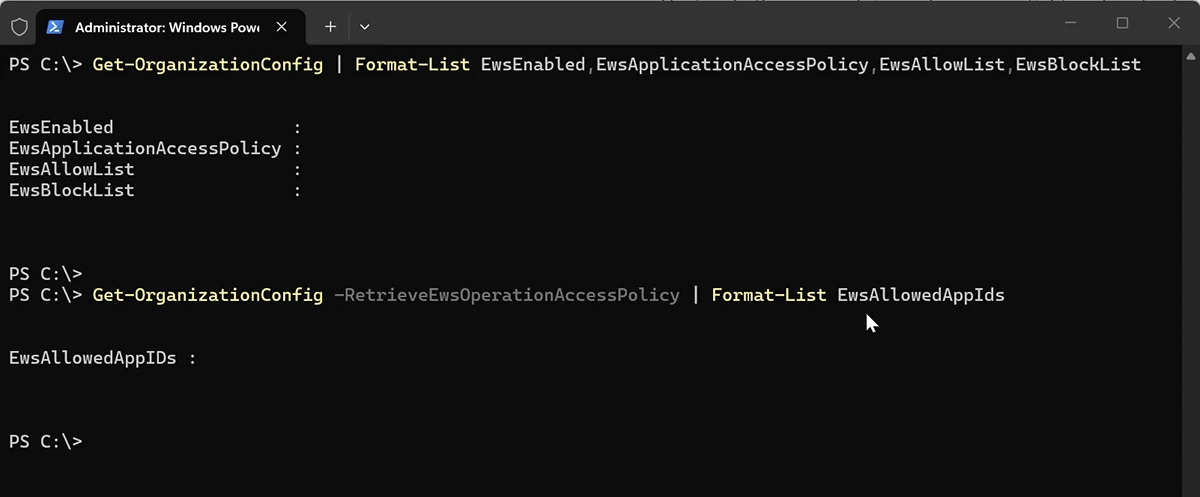
EwsEnabled or EwsAllowedAppIds.Connect to Exchange Online PowerShell and run two checks. This is the same connection you use for Exchange mail flow rules and other tenant-level Exchange work. The new allow list needs its own switch and will not appear in a standard Get-OrganizationConfig output:
Connect-ExchangeOnline

# Tenant-level EWS state and the older user-agent based controls
Get-OrganizationConfig | Format-List EwsEnabled,EwsApplicationAccessPolicy,EwsAllowList,EwsBlockList

# The new application ID allow list
Get-OrganizationConfig -RetrieveEwsOperationAccessPolicy | Format-List EwsAllowedAppIDs
The second command matters. Without -RetrieveEwsOperationAccessPolicy the allow list does not come back, and it is easy to look at an empty result and conclude nothing is configured when something is.
If EwsEnabled returns blank, your tenant is in the $null default state — the one that gets automatically switched off on 1 October.
Step 3: Configure the Allow List Before the Deadline
If your discovery in Step 1 found applications that genuinely still need EWS and cannot be migrated in the next few weeks, configure the allow list now. This buys you time until April 2027 rather than having the decision made for you in October.
Microsoft will pre-populate an allow list in September 2026 for tenants that have not created one, derived from observed EWS usage. That is a helpful safety net, but it is built from telemetry — it cannot see a quarterly job that has not run, or an application that is dormant but still business-critical. Treat anything Microsoft populates as a starting point to validate, not a completed inventory.
Add to the list rather than replacing it
This is the step most likely to cause an outage. Set-OrganizationConfig -EwsAllowedAppIDs writes the whole list as a comma-separated string, so passing a single App ID silently removes everything already there — including anything Microsoft pre-populated or a colleague added.
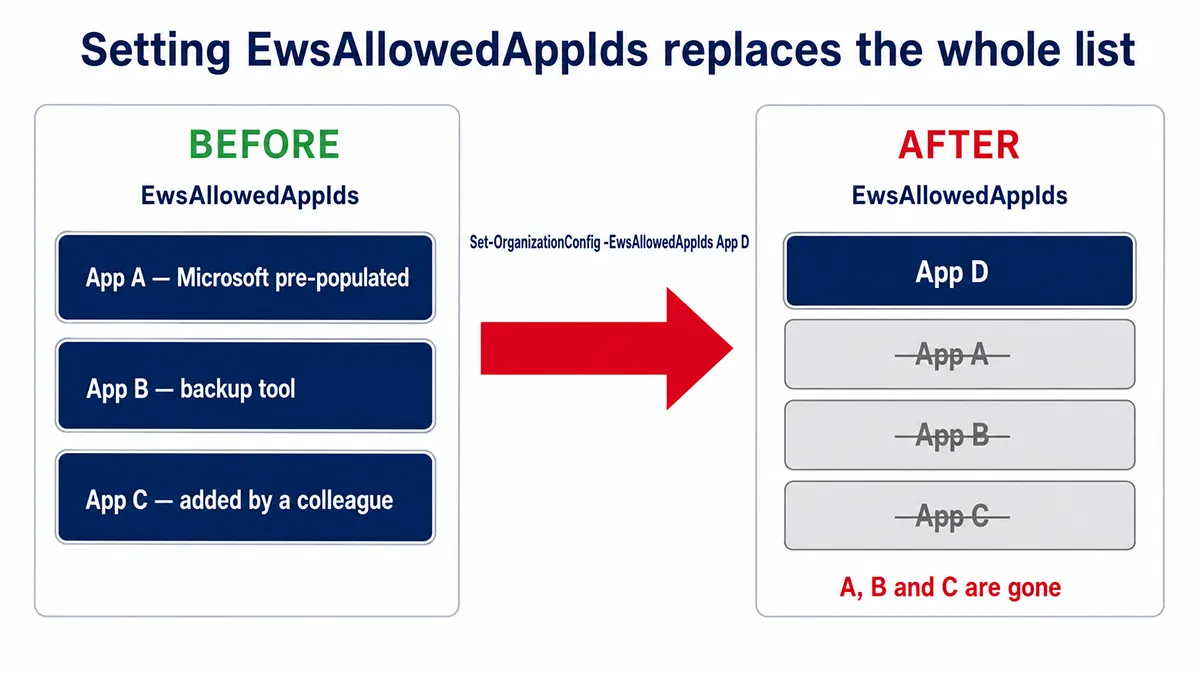
Read the current list, append, then write the combined set back:
# Read what is already configured
$current = Get-OrganizationConfig -RetrieveEwsOperationAccessPolicy |
  Select-Object -ExpandProperty EwsAllowedAppIDs

# Define the new App ID to add
$newAppId = "00000000-0000-0000-0000-000000000000"

# Combine existing and new values, dropping blanks and duplicates
$updated = @($current, $newAppId) | Where-Object { $_ } | Select-Object -Unique

# Write the combined list back as a comma-separated string
Set-OrganizationConfig -EwsAllowedAppIDs ($updated -join ",")

# Explicitly enable EWS at tenant level
Set-OrganizationConfig -EwsEnabled $true

# Confirm both settings applied
Get-OrganizationConfig -RetrieveEwsOperationAccessPolicy |
  Format-List EwsEnabled,EwsAllowedAppIDs
Note the -join ",". This parameter expects a comma-separated string rather than a PowerShell array, which is a common cause of the command not behaving as expected.
Replace the sample GUID with a real application ID from your Entra app registrations or your vendor’s documentation. The placeholder value is illustrative and will not match anything in your tenant.
EwsAllowedAppIDs is the new application-level allow list built for this retirement and identifies apps by application ID. It is not the same as the long-standing EwsAllowList and EwsBlockList parameters, which filter by user agent string. Setting the old ones does not opt you out of anything. Microsoft’s announcement covers the distinction in Introducing EWSAllowedAppIDs.Step 4: Plan the Migration to Microsoft Graph
The allow list is a stay of execution, not a solution. Everything moves to Microsoft Graph before April 2027.
For each application you identified, the path depends on who owns it:
- Vendor products: contact the vendor for their EWS retirement statement and the version that uses Graph. Most major vendors have published one. Budget for an upgrade, because Graph support is frequently gated behind a newer release rather than a patch.
- In-house code: run the EWS Analyzer first, then use Microsoft’s EWS-to-Graph mapping resources to identify which Graph APIs replace the operations your code actually calls. Microsoft has also published a tutorial for AI-assisted analysis and refactoring of EWS code, worth reviewing before anyone starts rewriting by hand.
- Anything unowned: if nobody can say what an app does or why it exists, that is your answer. Turn it off in a controlled way now rather than discovering its purpose when it breaks in April.
Expect the permissions model to be the real work. Graph uses granular scopes rather than the broad impersonation EWS relied on, so migration usually means revisiting how the application authenticates, not just swapping endpoints.
Prioritise by blast radius, not by ease. A backup product failing silently is far worse than a room booking panel showing an error, even though the panel is the more visible problem.
What Happens If You Do Nothing
On 1 October 2026 your tenant has EwsEnabled set to $false as part of the staged rollout. Every application depending on EWS stops working at that point. In practice that tends to mean:
- Mailbox backup jobs stop collecting new items
- Migration batches fail or stall part-way
- CRM and helpdesk sync stops filing messages against tickets
- Room booking panels stop showing availability
- Signature tools stop applying to new or updated mailboxes
- Custom scripts fail with authentication or access errors
The failure mode is what makes this worth acting on early. EWS applications do not usually fail loudly. Backups report success while backing up nothing. Sync jobs stop syncing without alerting. You often find out weeks later, when someone needs the thing that stopped working.
You can re-enable EWS and configure the allow list after 1 October. But you will be doing it under pressure, with something already broken, and without knowing which of the several things that failed that morning is the one you are being asked about.
Final Thoughts
This is one of those changes where the technical work is small and the discovery work is everything. Setting two PowerShell parameters takes five minutes. Working out which of your integrations depend on EWS, who owns them, and what happens when they stop is the actual project.
If you do nothing else this week, run the EWS usage report. It takes two minutes and tells you whether you have obvious current EWS activity. If it comes back empty, do not close the risk — an empty report only means nothing called EWS inside the reporting window. Check app registrations, sign-in logs, audit logs, vendor documentation and your own scheduled scripts before you decide the tenant is clear.
For the other requests that land on a Microsoft 365 administrator regularly, see our guide to common Microsoft 365 admin tasks.
Frequently Asked Questions
When exactly is Exchange Web Services being retired?
Phased enforcement begins on 1 October 2026, when tenants that have not configured an allow list have EWS automatically disabled. EWS is permanently disabled in Exchange Online on 1 April 2027, regardless of tenant settings. The practical deadline for administrators is the end of August 2026, which is the cut-off for opting out of the October automatic change.
Does EWS retirement affect on-premises Exchange Server?
No. This retirement timeline applies to EWS in Exchange Online. On-premises Exchange Server is not retired on the same schedule. Hybrid organisations should still check whether any cloud-connected application depends on Exchange Online EWS, because those calls are in scope.
Is Outlook affected by EWS retirement?
This does not mean Outlook or Outlook on the web will simply stop working for users on 1 October. Microsoft is removing EWS dependencies from its own products as part of the retirement work. Administrators should focus on third-party applications, vendor tools and custom automation that call EWS directly.
What is EwsAllowedAppIDs?
EwsAllowedAppIDs is an Exchange Online organisation setting listing the application IDs permitted to access EWS while EWS is enabled. From the October 2026 enforcement phase, enabling EWS is not sufficient on its own — an application must also appear on this list.
Why does EwsAllowedAppIDs return nothing when I check it?
The allow list does not appear in a standard Get-OrganizationConfig result. You need the RetrieveEwsOperationAccessPolicy switch: Get-OrganizationConfig -RetrieveEwsOperationAccessPolicy | Format-List EwsAllowedAppIDs. Without it, a configured list can look empty.
How do I add an App ID without removing the existing ones?
Setting EwsAllowedAppIDs writes the entire list, so passing a single value replaces everything already configured. Read the current list first, append your new App ID, then write the combined set back as a comma-separated string using the -join “,” pattern. The parameter expects a string rather than a PowerShell array.
Will Microsoft create the allow list for me?
Microsoft pre-populates an allow list in September 2026 for tenants that have not created one, based on that tenant’s observed EWS usage. It is a useful safety net but not a complete inventory, because telemetry cannot see dormant applications or jobs that have not run recently. Validate anything Microsoft populates against your own discovery.
How do I stop EWS being disabled in my tenant on 1 October?
Configure the EwsAllowedAppIDs allow list with the application IDs that still need EWS, and set EwsEnabled to $true using Set-OrganizationConfig in Exchange Online PowerShell, before the end of August 2026. Tenants that do this are excluded from the automatic switch to disabled.
How do I find out which applications use EWS in my tenant?
Use several sources together. The EWS usage report shows activity volumes and SOAP actions. Entra sign-in logs filtered on the Office 365 Exchange Online resource give you named applications. The Unified Audit Log EwsAccess activity catches intermittent jobs. Inventory Entra app registrations holding EWS permissions, and run the EWS Analyzer against in-house code that may not appear in any log.
Is EwsAllowedAppIDs the same as EwsAllowList?
No. EwsAllowedAppIDs is the new application-level allow list introduced for this retirement and identifies apps by application ID. EwsAllowList and EwsBlockList are older parameters that filter by user agent string. Configuring the older parameters does not opt your tenant out of the October change.
What typically still uses EWS?
Mailbox backup products, migration utilities, CRM and helpdesk email sync, enterprise signature management, third-party archiving and eDiscovery add-ons, room booking panels, and in-house scripts written against the EWS Managed API. In-house scripts are the highest risk because no vendor is sending you a migration notice about them.
What should I migrate EWS applications to?
Microsoft Graph API. Most common mailbox operations have direct Graph equivalents, but the permissions model differs — Graph uses granular scopes rather than the broad impersonation model EWS relied on, so migration usually means revisiting how the application authenticates, not just swapping endpoints.
What happens to applications when EWS is disabled?
They stop working, usually without an obvious error. Backups can report success while backing up nothing, sync jobs stop silently, and signature deployment stops applying to new users. The quiet failure mode is the main reason to complete discovery before October rather than after.