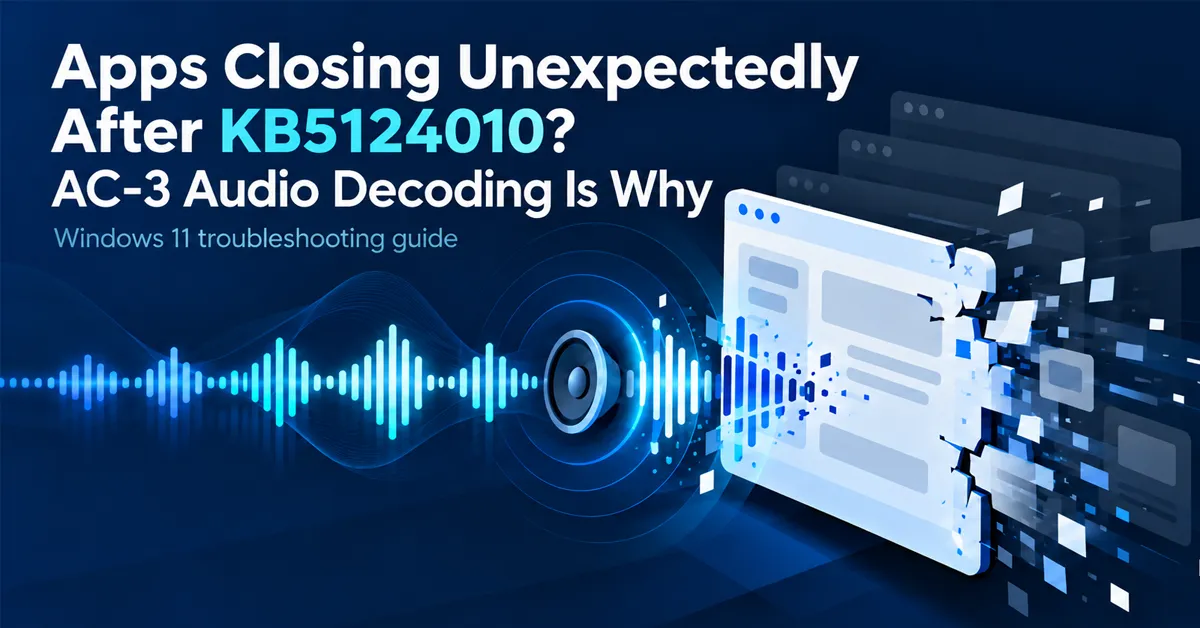
An application that worked last week now closes the moment it tries to play audio. Sometimes it will not launch at all. There is no error dialog, no crash report worth reading — the window simply disappears.
If the device installed KB5124010 (22 September 2026) or later, and the crash tracks audio playback, the likely cause is Windows’ built-in AC-3 audio decoder, the component that handles Dolby Digital sound.
What you will actually see
Microsoft describes the behaviour as varying by what the application does:
- The application fails to launch at all
- Or it closes without warning partway through
- Or it works normally until a specific feature is used — playing music, starting a video, triggering a sound effect
That third pattern is the one that wastes people’s time. The app opens fine, so the update gets ruled out early, and the real trigger only becomes obvious after several reproductions.
Which applications are affected
Microsoft names categories rather than products: games, media players, and certain productivity applications.
The useful distinction is not what kind of app it is — it is whose decoder it uses.
| Application type | Likely affected? |
|---|---|
| Older apps relying on Windows’ built-in audio decoding | Yes — this is the group at risk |
| Modern apps that bundle their own codecs | No — they never call the Windows component |
| Apps that play only non-AC-3 audio | No |
In Microsoft’s words, the component involved is “most commonly used in legacy applications that still rely on Windows built-in audio decoding,” and many modern applications “include their own audio decoding components.”
Practically, that means the risk sits with older software: media players that predate bundled codecs, games from an earlier era, and long-lived line-of-business tools that nobody has recompiled in years. Those last ones are the quiet problem in a managed estate, because they are exactly the applications with no vendor left to call.
Confirming it is this and not something else
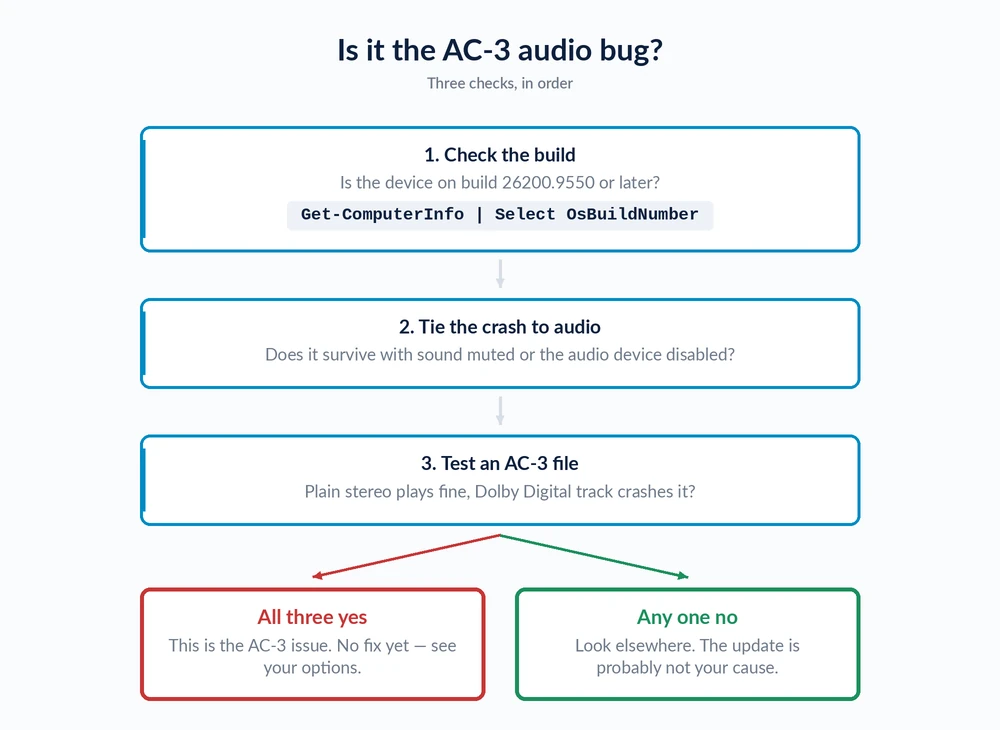
Three checks, in order:
1. Check the build. The issue starts with the 22 September update.
Get-ComputerInfo | Select-Object OsName, OsVersion, OsBuildNumber
Get-HotFix | Sort-Object InstalledOn -Descending | Select-Object -First 5
If the device is on one of these builds or later, it has the affected update:
- Windows 11 24H2: 26100.9550 or later
- Windows 11 25H2: 26200.9550 or later
- Windows 11 26H2: 26300.9550 or later
Windows 11 26H1 runs on a separate servicing branch and is not listed among the affected versions.
2. Tie the crash to audio. Launch the application with sound muted at the Windows level, or with the audio device disabled in Device Manager. If it survives when it previously crashed, audio is implicated.
3. Test a file you know is AC-3. Dolby Digital audio is common in older video files and DVD rips. If the same application handles a plain stereo file fine and dies on an AC-3 track, that is about as close to confirmation as you will get without a debugger.
ntdll.dll fault is common here and tells you nothing either way.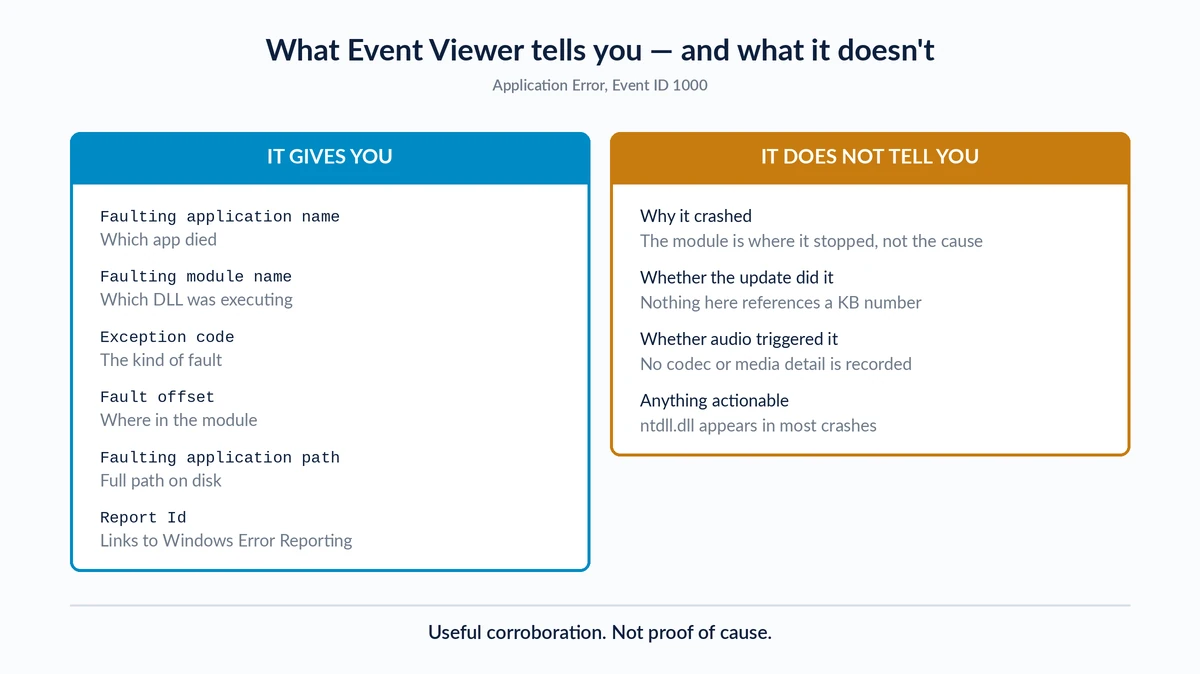
What you can actually do
I want to be straight about this: Microsoft has published no workaround, and there is no clean fix. Anyone telling you otherwise is guessing. What exists is a set of trade-offs.
Use an application that brings its own codec
The most practical option for a single affected app. If a media player bundles its own decoders rather than calling the Windows one, it sidesteps the broken component entirely. For playback this is usually easy. For a game or a line-of-business tool, there is no equivalent — you cannot swap the engine.
Uninstalling the update — read this before you do
Technically possible. Rarely the right call, for two reasons that are easy to miss:
- KB5124010 is the update that fixed the domain trust failure. Removing it re-exposes domain-joined machines to the Machine Identity Isolation problem — see our guide to the trust relationship error after KB5124008. You would be trading an audio bug for a sign-in outage.
- You also lose everything else the update carried, and the next cumulative update will reinstall it anyway.
If you genuinely must, the usual route applies — but treat it as a stopgap measured in days, not a solution. If the machine is also sluggish or misbehaving in other ways since the update, that is worth separating out first; our guide to diagnosing performance problems after an update covers that ground.
Pausing updates
Only useful if you have not installed it yet. Buys time, does not fix anything, and leaves you unpatched. For a home machine running one affected game, pausing updates may be reasonable for a short period. For managed or business devices, it should be a controlled update-ring decision, not an individual workaround.
The decision IT administrators actually face
This is where it gets awkward, and it is the part general coverage will skip.
KB5124010 fixes one serious problem and introduces another.
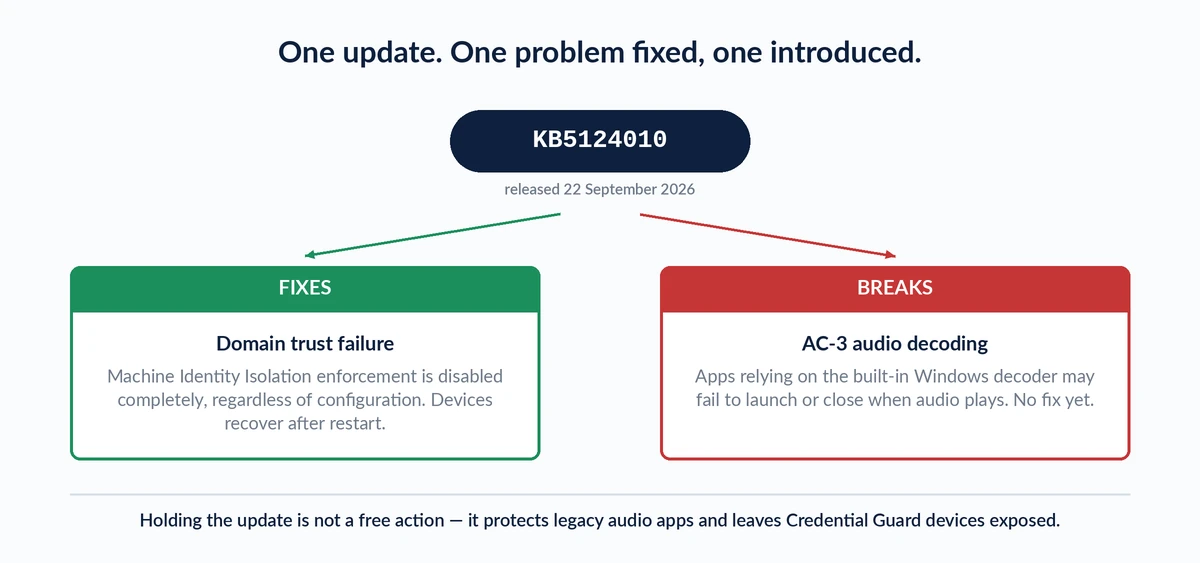
So “hold the update” is not a free action. Holding it protects legacy audio applications and leaves Credential Guard devices exposed to sign-in failures. Deploying it does the reverse.
Which way you go depends on something only you can assess: do you have devices with Machine Identity Isolation enabled against a pre-2025 domain functional level? If yes, the trust failure is the bigger operational risk by a wide margin — users unable to log in beats a media player crashing. If no, you were never exposed to that bug, and holding the preview update in a pilot ring while you survey for affected applications is defensible.
Either way, the useful work right now is the survey: find out which of your legacy applications decode AC-3 before the decision is forced on you.
What happens next
Microsoft has said it is working on a resolution for a future Windows update, with no date given.
The timing matters more than usual here, because of what KB5124010 is. As a preview release it has only reached machines that opted into optional updates — a small slice of the installed base. The contents of a preview update normally roll forward into the next monthly security update, which everyone receives.
October’s Patch Tuesday falls on 13 October, four days from now. If the AC-3 fix is not in that release, this stops being a problem for early adopters and becomes a problem for everyone.
That is reasoning from the normal servicing pattern rather than anything Microsoft has stated, so treat it as a thing to watch rather than a prediction. If you manage update rings, it is worth reading the October release notes on the day rather than a week later.
Final thoughts
The honest summary is that this one has no good answer yet. You can identify it, you can rule it out, and you can make an informed call about your update rings — but you cannot fix it, and nobody can.
What you can do is stop losing time to it. If an application started closing on you in the last fortnight and the crash tracks audio, you now know why, and you know not to spend an afternoon reinstalling it.
For other problems traced to recent Windows updates, see our guides to Windows 11 update error codes and update-related gaming failures.
Frequently Asked Questions
What causes apps to close after KB5124010?
Windows’ built-in AC-3 (Dolby Digital) audio decoder. Applications that rely on that component rather than bundling their own codec may fail to launch, or close unexpectedly when audio plays. Microsoft confirmed the issue on 2 October 2026.
Which Windows versions and builds are affected?
Windows 11 versions 24H2, 25H2 and 26H2, from the update released 22 September 2026 (KB5124010) onwards. The corresponding builds are 26100.9550 for 24H2, 26200.9550 for 25H2 and 26300.9550 for 26H2. Windows 11 26H1 is on a separate servicing branch and is not listed as affected. Microsoft lists no affected server platforms.
Do I even have this update?
Possibly not. KB5124010 is a preview release, meaning it is optional. It installs only if you went looking for it or have the setting to get the latest updates as soon as they are available turned on. Machines taking only monthly security updates will not have it yet.
Is there a workaround?
Microsoft has not published one. The practical options are to use an application that bundles its own audio codec, or to accept the behaviour until a fix ships. There is no registry change or setting that resolves it.
Should I uninstall KB5124010?
Usually not. KB5124010 is the update that fixed the domain trust failure caused by Machine Identity Isolation. Removing it re-exposes domain-joined devices to sign-in failures and strips other fixes, and the next cumulative update reinstalls it anyway.
Which applications are affected?
Microsoft names games, media players and certain productivity applications. The common factor is reliance on Windows’ built-in audio decoding rather than a bundled codec, which makes older software the main risk. Modern applications that include their own decoders are not affected.
How do I know it is this issue and not the application?
Check the build first, then test whether the crash tracks audio specifically. If the application survives with sound muted or the audio device disabled, and dies on AC-3 content but not plain stereo, that is a strong match.
Does this affect Windows Server?
No. Microsoft lists no affected server platforms for this issue.
When will Microsoft fix it?
Microsoft has said it is working on a resolution for a future Windows update. No date has been published and the issue is currently listed as Confirmed.
Should I hold KB5124010 in my update rings?
It depends on whether you have devices with Machine Identity Isolation enabled against a domain functional level below Windows Server 2025. If you do, the domain trust failure that KB5124010 fixes is the more serious operational risk. If you do not, holding the preview update in a pilot ring while you survey for affected legacy applications is reasonable.